Worms?
Teach your worm, then watch what it makes of it.
▶ Play Worms? free, in your browser, nothing to install
David S. Maynard's Worms? (Electronic Arts, 1983) is built on Paterson's worms, a mathematical game: worms crawl over a grid of points, eating the paths between them. Whenever a worm meets a situation it has never seen, it has to be told which way to go, and from then on it always does the same there. A worm that eats the last path of a point scores it; a worm that reaches a point with no path left dies.
Up to four worms share the grid: taught by players, played by the computer (AUTO), wild (random from the start), or worms taught in earlier games and saved under a name. While no one plays, the computer's worms give a demonstration.
This port follows the Commodore 64 version, translated word by word from its Forth source, which Maynard released under the MIT license. Online, each worm can be a player of its own.
Screenshots
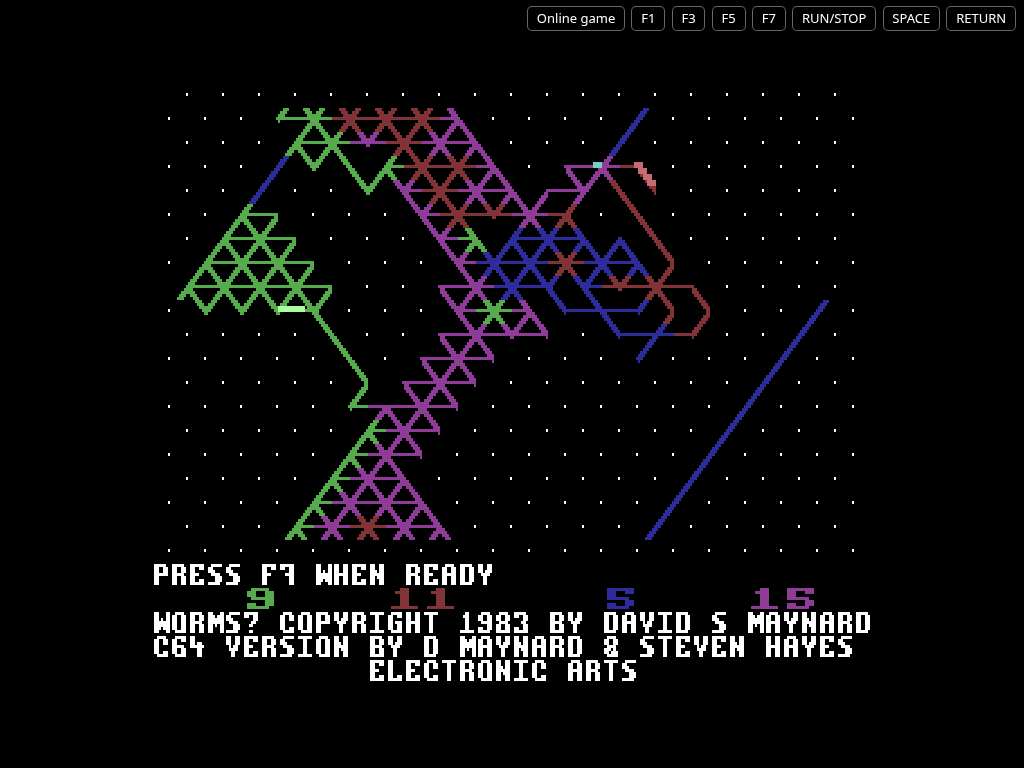
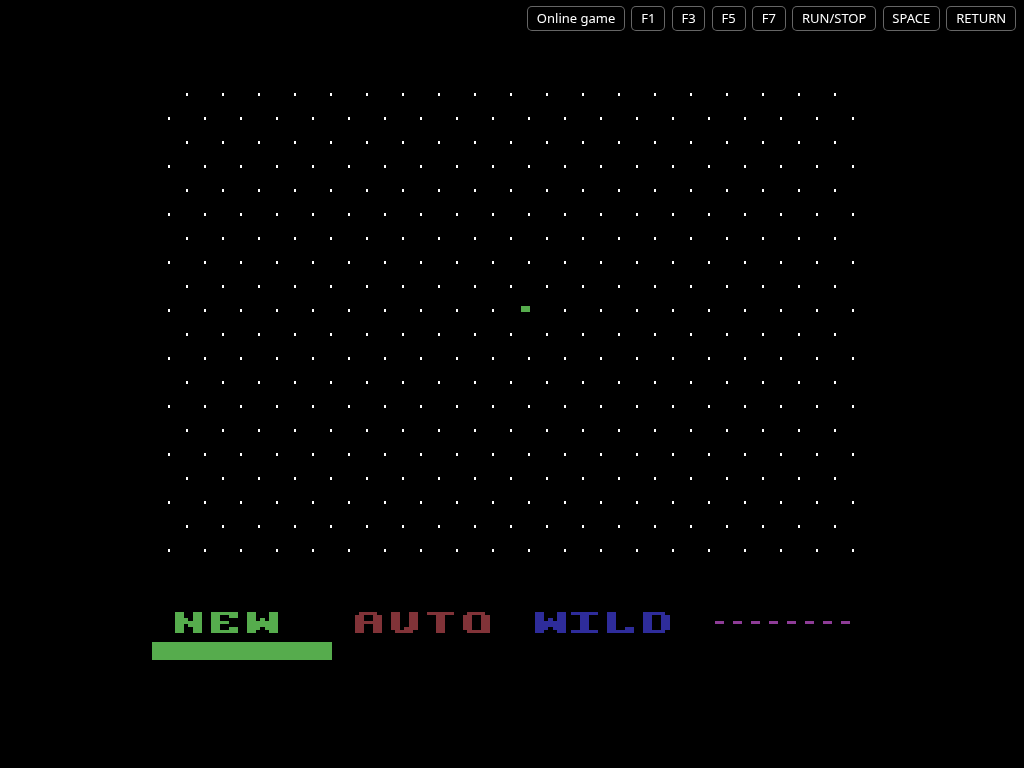
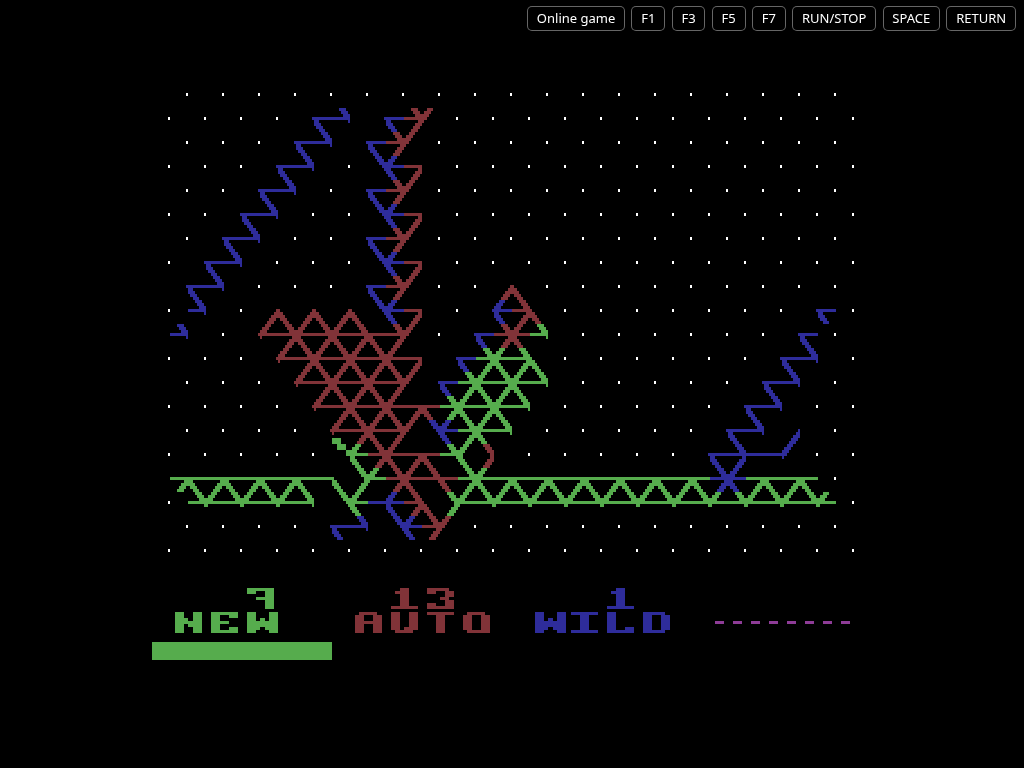
Controls
| F7 | Start a game (and end the demonstration) |
| F5 | Select the next worm |
| F3 | Change the selected worm: none, NEW (taught by a player), AUTO (the computer), WILD, or as it is (its name) |
| Space | When a worm asks: show the next free path |
| Return (or any other key) | Take that path; the worm remembers it |
| 0–9 | Speed (9 fastest, 0 slowest) |
| Esc (RUN/STOP) | Pause; again to go on |
| F1, F3, F5, F7 in a game | End the game (F1 starts the program over) |
| L, S, U in the menu | Load a worm into the selected one, save it under a name, update its file |
| Online game (beside the picture) | The lobby: up to four players, one worm each |
The original
Worms? (1983) by David S. Maynard (C64 version with Steven Hayes); Commodore 64. This port follows Commodore 64 version ("MASTER OCT. 9, 1983. COMMODORE 64 FINAL", savetz/worms), the same rules, levels, graphics and sounds, running natively in the browser. License: MIT (Licenses & source). Players: 1–4 (on one computer or online).
More free games
- 2048: Slide the tiles together until one of them is 2048.
- A Dark Room: Wake up in the dark, build a fire, and walk out into a world that wants you dead.
- Abuse: Run, jump and shoot through an underground prison overrun by mutants.
- Ballerburg: Two castles, two kings, one mountain between them.
- Biniax: Take the right pair before the field scrolls over you.
- Colossal Cave Adventure: The first text adventure: explore a cave by typing.
- Core War: Write programs that fight for a computer's memory.
- FreeCol: Found colonies in the New World, trade with Europe and the natives, and win independence.
- Frozen Bubble: Penguins shoot coloured bubbles: three of a kind fall, and the ceiling comes down.
- GLtron: Four lightcycles, one grid, and a trail that kills you as surely as the wall.
- GNU Chess: The GNU Project's chess program, at its own prompt.
- Hunt the Wumpus: Hunt a monster through a cave of twenty rooms.
- Maelstrom: Asteroids, alien fighters, and one very small ship.
- Moria: Go down into the mines of Moria and face the Balrog.
- NetHack: Descend into the Mazes of Menace and bring back the Amulet of Yendor.
- Netrek: Four empires, sixteen ships, one galaxy: team space combat and planet conquest.
- Passage: A whole life in five minutes.
- Pinball Construction Set: Build your own pinball table, then play it.
- Sopwith: A biplane, a row of targets, and a sky full of trouble.
- Teeworlds: Small round tees with grappling hooks and big guns: fast online deathmatch and capture the flag.
- Tux Racer: Race Tux down the mountain, collect herring and beat the clock.
- Tux, of Math Command: Zap the falling comets by solving their math problems.
- XPilot: Thrust, turn and shoot it out with other pilots in a space arena.